Dog poop trash can setup: outdoor bins and what South Sound haulers take
You scoop it. You bag it. And then you stand there in the drizzle holding a warm knotted bag, doing the same math you do every single day: garage, side yard, or straight into the curbside cart that won’t get emptied until Thursday. The dog poop trash can is the part of this chore nobody plans for, and it’s the part you actually deal with twice a day from Lakewood to Silverdale to Olympia. Everybody has an opinion about scoopers. Almost nobody thinks about the container the bags live in for the next six days.
So let’s fix that. Here’s what to use, where to put it, and what Pierce, Kitsap, and Thurston County actually say about where the bags are allowed to end up.
The pile is bigger than you think
Pierce County counts more than 206,000 dogs inside its lines. That works out to roughly 68,000 pounds of waste every single day, or about 34 tons countywide, according to Pierce County Planning and Public Works. Over in Kitsap, the numbers the City of Bremerton publishes on behalf of the Kitsap Stormwater Consortium put the county’s roughly 15,000 dogs at about three quarters of a pound each per day, which lands at more than five tons daily.
Your household’s share of that is small, but it isn’t nothing. Two dogs going twice a day is around twenty-eight bags a week. All twenty-eight of them have to sit somewhere between the moment you scoop and the moment the truck comes. That somewhere is the whole question.
Every county here gives the same answer: bag it, trash it
There is no local disagreement about the destination. Pierce County’s guidance is to pick it up, bag it, and put it in the trash, and it is blunt about the reasoning: landfills are designed to handle pet waste safely, while yards, trails, streets, parks, toilets, and compost piles are not.
Down in Thurston County, the Stream Team, jointly run by the stormwater utilities of Lacey, Olympia, Tumwater, and the county, boils it down to four words on every sign they hand out: scoop it, bag it, trash it. Kitsap’s guidance says to double bag it and toss it out with your garbage.
So the endpoint is settled. Regular garbage, not anything else. What almost no agency tells you is what the bags are supposed to live in for the six days in between, which is exactly where most households improvise badly.
What bagged waste must never go into
Before we get to the good containers, here are the three wrong ones. We see all of them.
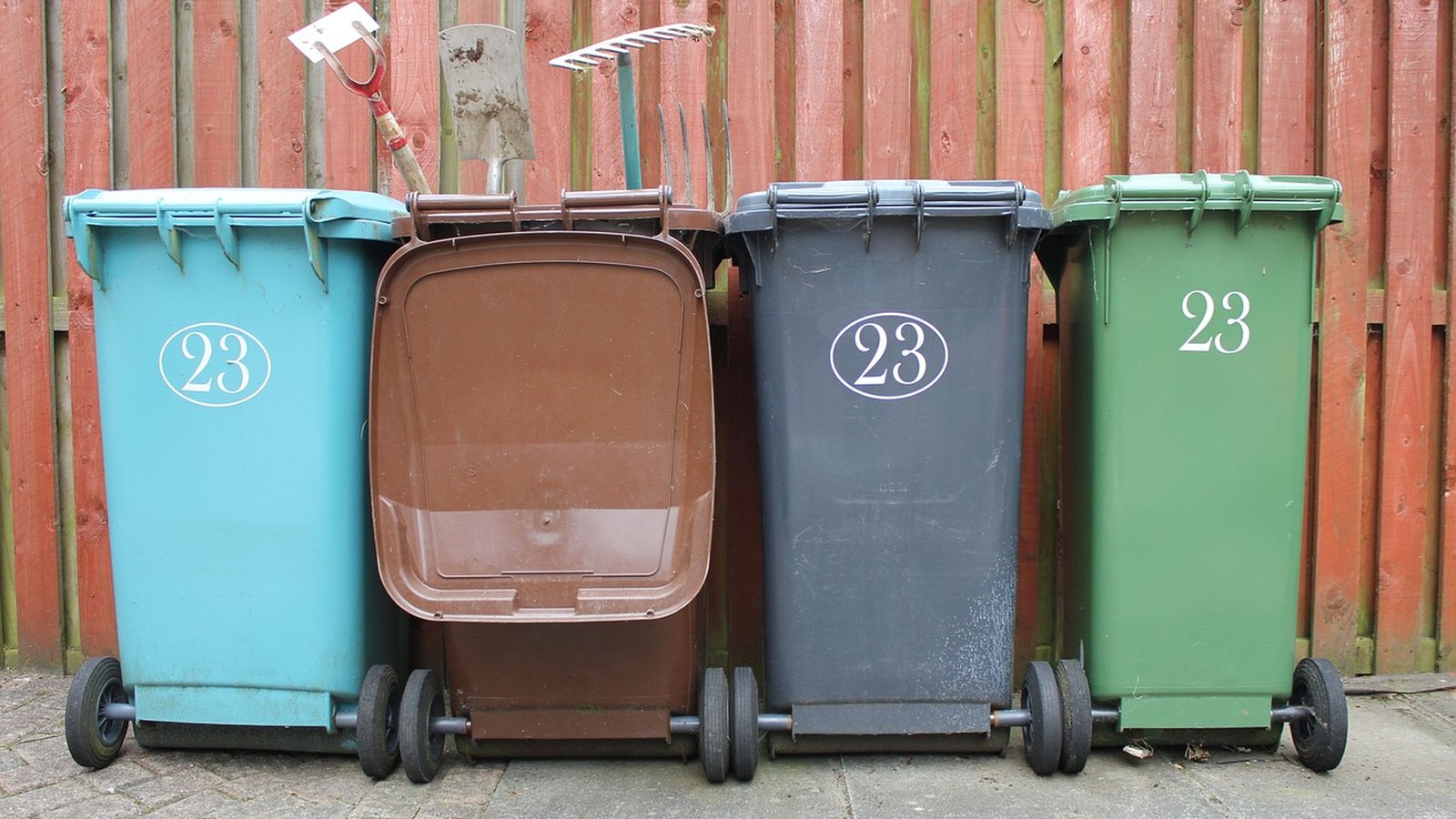
- The food and yard waste cart. This is the single most common mistake in Tacoma, and the City of Tacoma is explicit about it: pet waste contains harmful bacteria and microorganisms that can be hazardous if composted, so always bag it and put it in the garbage instead. The brown cart is for grass, leaves, and food scraps. It is not for the dog.
- A backyard compost pile. Pierce County’s answer here is a flat no, because most home piles never get hot enough to kill the organisms in dog and cat waste. Worth noting that a purpose-built in-ground digester is a completely different animal from a compost heap, and we get into that difference in our guide to eco-friendly dog waste disposal.
- Anything that drains to the street. A bin sitting over a driveway crack that feeds a storm drain is a slow-motion version of leaving the waste on the lawn. The Stream Team’s number for this is worth remembering: a single gram of dog poop, about the size of a pea, can carry 23 million fecal coliform bacteria, which is close to twice what’s in human waste.
Flushing: Pierce and Kitsap do not agree
This one surprises people, and it’s a genuine local split, so check which side of the water you’re on.
Pierce County says no, do not flush pet waste down the toilet. Their reasoning is that animal waste carries different pathogens than human waste and isn’t fully treated in the wastewater process, and they cite the Washington State Department of Ecology on bacteria from dog waste ending up in shellfish.
Kitsap’s guidance, through the Bremerton page, splits it. If your house is on public sewer, you can flush dog waste. If your house is on a septic system, never flush it. That second half is not optional. A septic tank is a small biological system and it does not need the extra load or the pathogens.
Two things hold no matter where you live. The bag never goes down the toilet, only the waste. And if you’re on a septic system anywhere in the South Sound, that toilet is not your disposal plan.
What actually makes a good dog poop trash can
Now the container itself. A dog poop trash can has a harder job than a kitchen bin, because it holds something biologically active outdoors through both a dry August and a soaking October. Here’s what matters.
A lid that latches or seals. Not a lid that rests on top. Raccoons work the ravines and greenbelts all through Gig Harbor, University Place, and the Puyallup valley, and a loose lid is an invitation. Crows will manage it too. A latch, a bungee, or a gasketed step-can lid all work.
Hard sides. Soft-sided and wire-frame bins hold odor in the fabric and never fully come clean. Rigid plastic or galvanized metal you can hose out is the move.
A removable liner. You want to lift one contractor-grade bag out on collection day, not tip the whole bin and lose half of it down the driveway. A liner also means the bin itself stays reasonably clean, which is the difference between hosing it out monthly and hosing it out never.
Sized to your actual gap. Most South Sound households are on weekly collection. Size the bin for seven days of your dog’s actual output plus a margin, not for the smallest thing that fits behind the gate. An undersized bin gets overfilled, which means the lid stops sealing, which is how every bin problem starts.
Wheels if it travels. If the bin itself goes to the curb, it needs wheels and a handle. If you’re transferring bags into your hauler’s cart on collection night, it doesn’t.
What you don’t want is the decorative open-top can from the garden center, or a cardboard box, or the corner of the garage where the bags just accumulate in a pile. We’ve been shown all three.
Where to put it
Placement does more work than the bin itself.
Keep it out of direct afternoon sun. On most South Sound lots that means the north or east side of the house, or under the eave line. Heat is what turns a sealed bin into a problem, and our July and August afternoons get hotter than people expect.
Keep it out of the attached garage. That wall is shared with your house, and once odor gets into a closed garage in summer it stays.
Keep it off wood decking and away from the hose bib and any storm drain. If the bin ever leaks, you want that happening on gravel or concrete you can rinse, not on cedar boards that will hold the stain and the smell. If you’ve already got that problem, our post on dog waste odor control in PNW yards covers what actually neutralizes it.
And keep it somewhere you’ll actually walk past. A bin tucked behind the shed at the back fence line is a bin that gets skipped in the rain, and skipped bins are how a yard turns into a project.
The August bin and the October bin
Around here the same container fails in two completely different ways, six weeks apart.
The August failure is flies. A warm bin with an imperfect seal attracts them fast, and once they’ve laid eggs, maggots follow quickly. Prevention is the only real fix: seal the lid every time, don’t overfill, keep the bin in shade, and rinse it out with an enzyme cleaner rather than bleach, which just masks things and doesn’t break down the organic residue.
The October failure is water. Our rain comes back to the South Sound in earnest in late September, and a bin left uncovered fills up. Now you have a container of liquid that leaks a slurry down the driveway toward the nearest storm drain, and that drain runs to a creek and eventually to Puget Sound. Do not drill drainage holes in the bottom of a waste bin, which is advice we’ve genuinely seen given. Just keep the lid closed and put the bin somewhere with overhead cover.
Fall wind is the quiet third problem. Get a strap, a wall bracket, or a spot where the bin sits between the fence and the house. A tipped bin on a windy November night is a bad Saturday morning.
HOAs and rentals: the station is not a trash can
If you manage a property, one distinction saves a lot of grief. A pet waste station dispenses bags and holds a receptacle. That receptacle is not a garbage can, and it needs its own scheduled service, or it overflows, residents stop using it, and compliance collapses. We wrote up the schedules and the common failure modes in our pet waste station maintenance guide.
Worth knowing: Pierce County offers a free pet waste station to neighborhoods with a problem in a common area, while supplies last, if you live in unincorporated Pierce County. Thurston County runs a similar program for qualifying HOAs, neighborhoods, and schools, and residents inside Lacey, Olympia, or Tumwater apply through their own city. The hardware is the easy part. The refill and service schedule is what makes it work.
Or you can skip the can entirely
Here’s the honest version. The best outdoor bin in the world still means you’re handling bags, hosing out a container, and timing your week around a truck.
The other option is that the waste never touches your cans at all. We handle weekly and twice-weekly scooping across Pierce, Kitsap, and Thurston counties, bag it, and haul it off your property, so there’s nothing sitting by the gate between visits. And if you’re staring at a backlog rather than a weekly routine, start with our guide to disposing of large amounts of dog poop before you go buy a bigger bin.
Either way, get the container right or get rid of it. The one thing that doesn’t work is a pile of bags by the back door and a plan to deal with it Saturday.
Let Us Haul It Away
We scoop, bag, and take the waste off your property so your cans stay clean. Weekly and twice-weekly service across Pierce, Kitsap, and Thurston counties.
Get a Free Quote